

8 stages, from scope check to licence in hand
This is the order of work we follow on every case. For how long each stage takes, see the service timeline.
-
Product scope check
Identify which Compulsory Standards cover the product, which specific criteria apply, and whether a manufacturing or an import licence is needed. This stage matters most: choose the wrong standard at the start and all the testing and paperwork has to be done again.
-
Categories, models and the Model List
The specific criteria differ from standard to standard: how many units make up one sample set, how many pieces or units the testing requires, what a sample may be chosen to represent for other models, and how many model variants one licence can cover. Grouping the models correctly from the start is where the applicant's cost is actually reduced.
-
Testing coordination
We coordinate with testing laboratories accredited to ISO/IEC 17025, submit samples, track results, and check the test report to be filed — the edition of the standard referenced, the scope of testing and the age of the report. For IEC reports you already hold, we check first whether they meet the conditions TISI accepts.
-
Preparing the application documents
Assemble the full set required by TISI: licence holder information such as the application form, power of attorney and company documents; documents for the manufacturer or importer; details of the product applied for; drawings, labels and the user manual; the model list; quality management system documents; and the factory operating licence. Where the site does not qualify as a factory, a certificate or document clearly identifying the production site is required.
-
Filing in e-License and follow-up
File on the applicant's behalf, answer the officer's questions, revise documents as requested, and report progress as the case moves, until the process is complete.
-
Factory assessment coordination
For factory audits we coordinate with the inspection body (TISI/IB), schedule the audit plan, prepare the required document list and send it to the plant before the audit date, arrange travel for the audit at plants both in Thailand and overseas, and follow corrective actions, if any, until the assessment report is received.
Factory assessment is carried out by an inspection body appointed by TISI, not by PTiS. Our role is coordination and preparing the applicant.
-
Filing the test report and the assessment report
Once we have received the test report and the assessment report, we file them in e-License. Approval takes 15 days.
-
Receiving the licence
We send the licence to the applicant as soon as the result is known, as an electronic file and by post, or however the client prefers.
Start at stage 1
Send photos, the label and the specification. We check the scope within one business day, at no cost.
Scope checkRelated
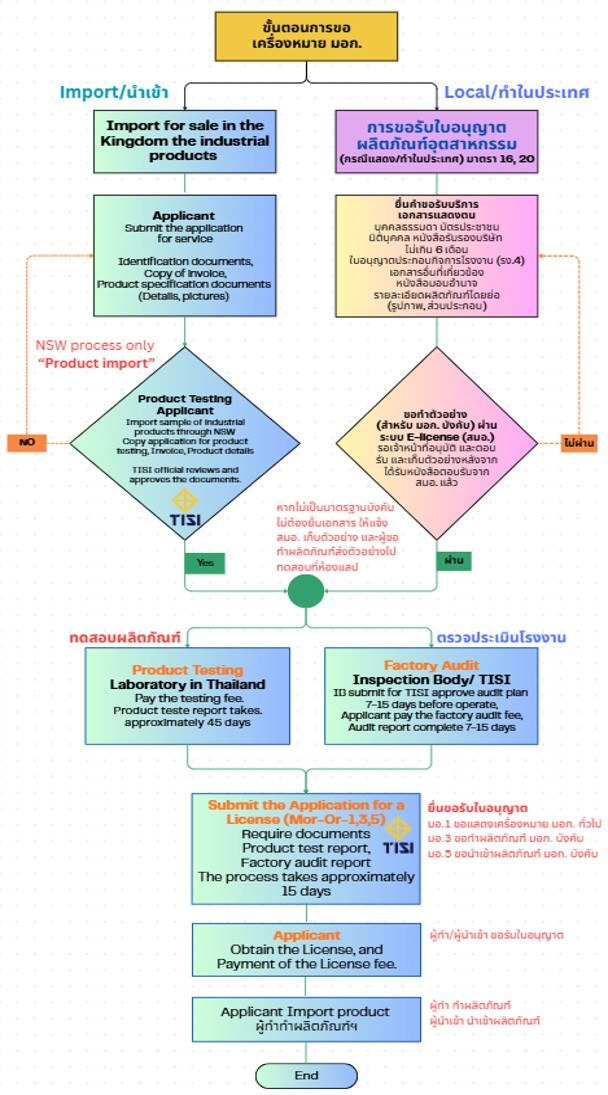
Import route and local manufacturing route
The diagram shows two routes that separate at the start: importing for sale in the Kingdom, and manufacturing the product in Thailand. Both converge at product testing and factory assessment before the licence application is filed.
The step most often missed is scope. If the specification does not clearly fall inside the scope of the standard applied for, a scope review must be filed through the E-scope system first, which adds roughly four weeks.
A licence is valid for 3 years from the date it is issued.
Want the timeline for your own case?
Send the product details and we will map the schedule for your product and point out where the bottleneck sits.